
Flying time is just under two hours. The bright-yellow Airbus departs from one of the many runways at Orlando International and, following the warm coast along Pensacola and Orange Beach, dives right into banks of thick cumulonimbus.
Breaking through the stuffy sky, a flat land of suburban neighborhoods guide our gliding path towards the airport, whilst the mighty Mississippi River meanders and flirts in curves of sassy river flow.
New Orleans – Louis Armstrong International Airport. The outdated terminal perhaps fails to transmit the character and fire of the jazz notes, yet the trip from Kenner to the CBD is a stave of pure Creole suburbia. Wooden houses painted in palettes of contrasting pink, green and red dot a constantly-wet grassland. If somebody had told me I landed in the depths of Belize, I would have never questioned it.
The city turns American as the empty bus cruises through the middle-class streets of Metaire. The weather turns hotter by the minute and the terrain sinks further in the bowl-like swamp in which the city lies in, some two meters below sea level.
At the CBD, the streets look empty at midday and the sun burns any sign of vegetation protruding over the dry asphalt. I soon realise that New Orleans in the summer is somewhat of a challenge. Air conditioning is a must and outdoor spaces are deserted until the sun once again turns the city bearable.

New Orleans is a city with character. At the boutique hotel, millenials sip on lemon caipirinhas amidst vintage books clinically placed over dark oak tables. My room could easily have been taken out of a Monocle magazine. Not often my style, I stay in the room for the afternoon at the cooling shelter of the air conditioning which induce a pleasant nap.
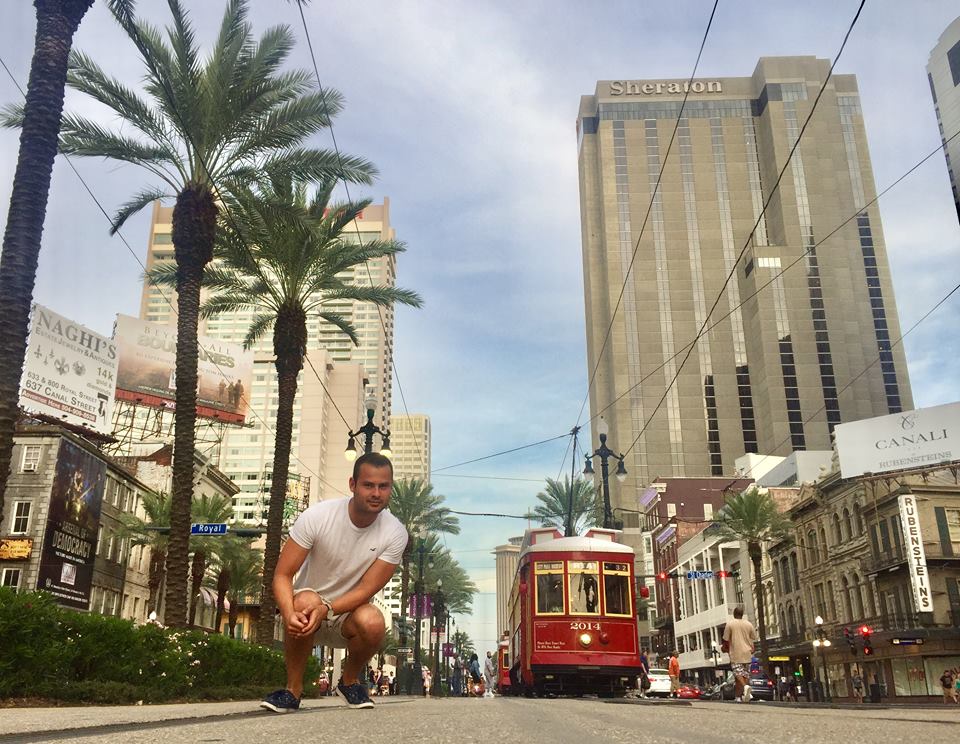
When exploring the city at sunset, two landscapes clash. Canal Street divides the new from the old. The ‘American’ neighborhood represented by the tall skyscrapers of the CBD (Central Business District), which morphs into a miniature version of Manhattan while cars clog its long avenues like a parade of white headlights, and the French Quarter, which at this time of the day enters into a trance of loud music, neon lights and drunk tourists.
I find comfort in the succulent softness of prawns smothered in white chardonnay and butter. Served in a large baguette, a ‘PO-boy’ provides enough calories for the day and sends me straight to bed for further digestion.


For the next couple of days, a ‘sightseeing strategy’ is developed. Early morning walks through the CBD bring me to carefully-thought cafes in which greek yogurt is served with fruit next to tables in which fixed-gear bicycles are mounted, through streets still untouched by the daily commuters and smiley African-Americans who exclaim ‘Good Morning’ whilst rushing to their workplaces uniforms on.
In the morning, the French Quarter is being washed and its previous night’s hangover is intended to be cured. Twenty-four hour bars offer cheap breakfast deals before the souvenir shops are open and sell cheap plastic beads. The houses painted in vibrant colours elegantly sport veils of black steel. Frames of French culture still defining the identity of the oldest part of the city until today.
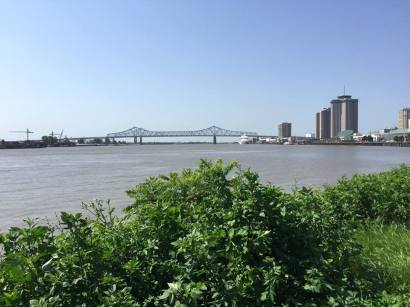
I understand the importance of the Mississippi when I stand next to its shore. Its current bringing sediments right from the heart of the United States and, along with it, the goods and customs of far along towns, farms and people, dividing the continent in two.
The French Market makes for a pleasant stop. Crocodile jerky is sold next to handcrafted toys, and aromatic dishes of Jambalaia , which is like a Spanish paella minus the saffron, are displayed on top of red plastic-covered counters.
Countless items crafted in leather take one back to the depths of the cajun times. To the once reptile-infested delta proudly claimed by the French in the early 1700s – named after Philippe II, Duke of Orleans- and later sold to the United States by Napoleon in 1803.
In the late afternoon, when the heat declares a truce, I am driven through streets that speak of natural disasters, for over eighty per cent of the city area succumbed to the effects of Hurricane Katrina some twelve years ago. Houses lie empty perhaps awaiting for new owners that will never arrive, broken windows display bare kitchen tiles covered with a thick line of mud, the water level at the worst of the flooding.
Beignets pastries swimming in a pool of white sugar combine perfectly with some Belizean coffee at a late tea time, the clock at twenty-twenty casting round dark shadows against a Southern sunset.


My last day is spent in the Garden District. Conveniently reached by a streetcar from Lafayette Avenue at the price of only two dollars, it is the best way to enter this idyllic suburb of fresh avenues sheltered under heavy oak trees.
Wooden mansions have now been divided into overpriced apartments and the place, once home to wealthy plantation landlords, is now victim of gentrification.


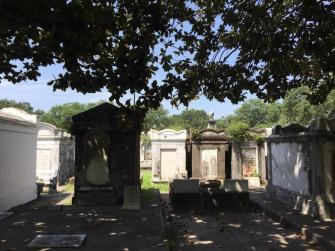
The Lafayette Cemetery Number 1 lies in the heart of the district. A democratic field encasing both American and French families, the soil too unstable to permit burial and instead, evoking to human creativity in the form of crafted mausoleums, at times housing entire clans in a small cement block.
The air conditioning saves me through both high-end shopping centres and flea markets for pauses of fresh air. The city turns dark for me for the last time at the sound of jazz music played in the background of a stale-smelling pub. Before sunrise, I take a bus to the airport with the company of lonely commuters who fall asleep on the tough seats whilst holding onto plastic bags.
My flight leaves Louisiana at the same time that the early morning light reflects in the numerous puddles of water and river arms, resembling a starlit sky turned backwards. Later in Orlando, the aircraft swerves around thick clouds of threatening black colour and lands, providing me with over eight hours in the Floridian peninsula.
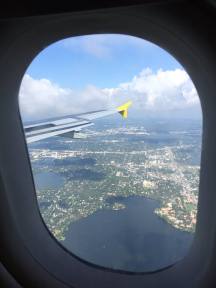
I take a public bus to ‘Outlet Paradise’ and, at ground level, I see how the whole region still shows signs of novelty, of housing estates built around the McMansion model near Lee Vista and streets turning modest and immigrant-resided at Oak Ridge.
I buy nothing but a couple of shirts. Covered in sweat, I return to the airport and grab a snack before boarding. Once again, I leave for Dublin at the end of the day, the green jet on an overnight flight gliding above the lights of New York, Boston and Gander, before the Atlantic opens up for us and land is only seen once again over the coast of Sligo, in time for landing.
 THE FLYING CAMBA
Nice entry – I love New Orleans, it is truly one of the few absolutely unique places.
Thanks for sharing.
LikeLike