

Reminiscing pieces of childhood forever stuck in my head echo through the chords of a guitar played by Silvio Rodriguez in my headphones. At the boarding gate, the Wikitravel link references Castilla as the ‘cradle of Spanish language’ or ‘the land of castles’.
At sunset, the aircraft banks left and points its nose South over the turbulent Cantabric Sea, whilst at night, the summer heat strikes like a wall in the face when the doors open at one of the many terminal buildings in Madrid Barajas Airport, the hilly terrain around us elevating in shallow embankments of street lights and dry dust.
Inside the terminal, the pungent smell of hot ‘bocadillos’ is soothed by the tangy flavour of cold beer, the clock at almost midnight announcing departures to distant places in the New World. Santo Domingo for the holiday-makers dressed in flowery dresses, Lima and Guayaquil for the migrants cramming parcels through the check-in counters.
Madrid looks desolate at midnight. Odd cars swerve through motorways carved in wide ditches that later turn into boulevards, boulevards that turn into streets converging into long underground tunnels at a time in which the city centre above us falls asleep at the sound of a self-sang lullaby.
The tunnel turns again into motorway and the bus seems to glide over neighbourhoods of small houses, whilst the urban train caresses the quiet streets with the last service of the day and the street lights disappear as the city grows distant. Signs read warnings for a long tunnel perforating through the stony core of the Sierra de Guadarrama, mental victory is proclaimed at the other side of it, the town of Olmedo now floating in the distant dark horizon.
I meet my family at the dusty makeshift bus stop, my heart fast pounding in relief at a time in which my limbs embrace an irresistible yet awkward hug. Smiles and greetings perhaps had in the most bizarre place of all, for I have finally reached a dear place in my heart and I can now placidly sleep in the small urban sprawl of Iscar.
The morning breeze enters the small pink room in gusts of hot and dry wind, whilst the sunshine blasts over a horizon of red ceramic tiles evoking colours only seen as bright in an Almodovar movie. My aunt serves me a pastry sweetened by a smile, and a cup of camomile tea warmed by the comfort of a family meal. I sip on my tea and cram words in Spanish over the small dining table, a familiar yet strangely atypical scenario.
I am left no time for horsing around and an agenda for the day has been carefully planned, for time is short and precious in these family visits.
Before I know it, I find myself darting through spotless regional roads linking villages in cobwebs of asphalt extending through the melancholically dry plains of central Spain. The summer is nearly gone and an atypically dry year has left a trail of dusty sadness behind, the tractors left idle in the middle of empty fields and titanic irrigator machines extending its sparklers in sepulchral silence.
Megeces and Cogeces are separated by pine trees hanging from a cliff. Iscar has the most beautiful creek, if only some water ran under the modern bridge and Remondo has no highlights. The local road joins the modern motorway and the soft hills surrender to the sturdy stone faces of the Guadarrama.
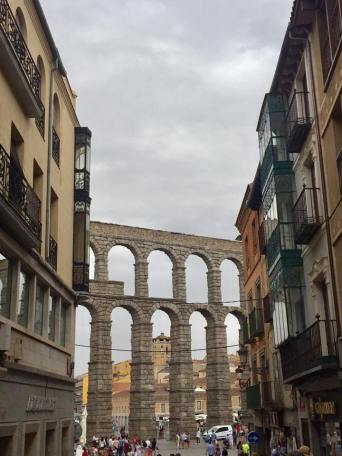
The road sign reads Segovia only meters before the motorway abruptly ends on a tight roundabout at the protest of the car brakes. The streets descend from the grassy plateau and conquer deep canyons through a series of bridges and tunnels that converge in the city’s architectural masterpiece: The Aqueduct.
Proudly stamped in the province’s coat of arms, its construction date remains as enigmatic as the precision used to build it. Historians claim a structure as old as Jesus, whilst the legend says the town was founded by Hercules himself. An Herculanean feat alright, over two-thousand years later, the perfectly fitted stone arches dramatically frame one of the prettiest towns in Spain.


Reservations for Narizotas are made over the phone and at lunch time, dishes of ‘cochinillo’ -which is basically roasted piglet- are handed with an absurd amount of house wine and baked potatoes, adding a Medieval taste to a dining room bisected by wooden beams and pale yellow walls. The alcohol has me giggling at the many memories of childhood and tears of laughter merge to those previously shed over the distance separating me from my family in time. I sober up at the Plaza Mayor, where a cold espresso is served before the strong winds descend upon us and blow empty glasses off the table next to us.
Valladolid is next. The largest city in Castilla y Leon once boomed with factories, yet the Spanish financial crisis hits its heart and perforated its soul right in the centre. With part of its population migrating to other parts of Spain or abroad, the town itself has no interesting highlights bar the stories of bygone strolls by the main square, of newlyweds parading at El Corte Ingles and weekend trips to the cinema. We finally encounter the night at Paseo de Zorilla and the people watching of a fresh night is best enjoyed with a small portion of churros con chocolate and one last espresso on ice.


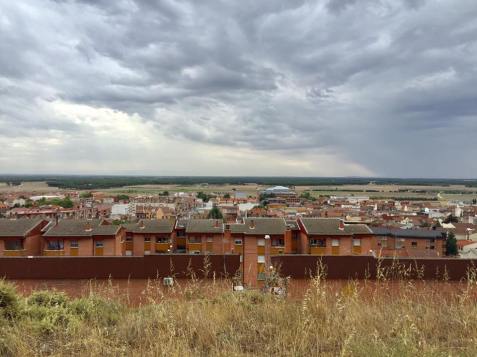
Storms catch up with us overnight and send shockwaves of mesmerising lighting through the heavy sky, extending its inclemency through the laziness of a Sunday in Central Spain. I hike up the castle in Iscar to contemplate a flat horizon of empty land whilst the storms play a battle with the distant mountains, and I am welcomed back in the apartment to a lavish homemade lunch of lechazo, the unweaned lamb meat melting at the touch of the lips in an almost sinful indulgence.
The rain shows no mercy over the plains, whilst inside the small pink apartment, the TV plays movies badly dubbed in Spanish, the real one.
I spend the evening at the small bar owned by this part of my family. Alcohol from the many glasses of beer are offset by small tapas religiously served with each serving and a long conversation with my cousin seems to perfectly fit the evening. Around me, the village revolves in a frenzy of pure tradition: the local alcoholic who spends his welfare money in a ‘chupito’ whilst his sons have already left for greener pastures, the father bringing his daughter to watch the late night football match whilst the offspring sips on hot chocolate, the hardcore men who never left town, their bald heads now shining under the dim lights of the bar at midnight like they have for the past three decades, their accents talking about better days in the past and desperately craving for better days in the future.
On Monday morning, the rhythm seems to have picked up in the plains. I say my goodbyes to my aunt and uncle over breakfast, yet the knot on my stomach prevents me from eating. A perfect visit, a fulfilling visit, a rather short visit.
I drive one of the cars to Valladolid, from where my cousin and I return to Cuellar. The streets of the old town are closed by the police and impatient onlookers are seen winding their way through the cobblestone pavements. The adrenaline increases at the sound of horns and from the top of the hill, the first bull descends in a confused frenzy of people.
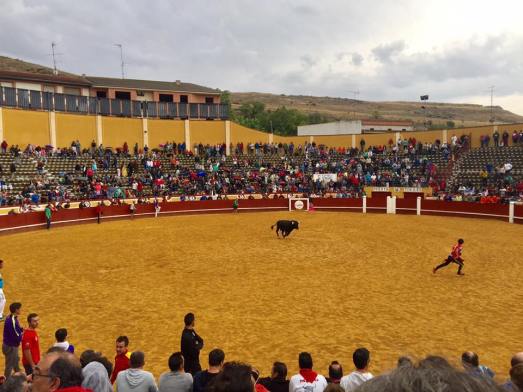
Cuellar claims the oldest bull chasing in Spain and thousands scream and run through its streets. I am warned to run at the sight of the second bull and my legs follow the crowd in a rush of adrenaline and confusion. The third bull hits a fence and attacks a girl who curls into fetal position some five meters away from where I stand. I scream, we all scream, the adrenaline explodes through my every muscle but we are all safe now.
At the Plaza de Toros, bullfighter aficionados tease one of the confused bulls in the pale yellow sand of the pit. The end of the fun bull chase is announced, the bullfighting perhaps would almost be too unbearable to watch.
My cousin hands me a souvenir over lunch and plans for further trips are made over a dish of pork and two beers with lemon. He drives me to Olmedo, the dusty outpost once again becoming an unlikely place for a family goodbye.
-‘It has been a pleasure, come visit more often’
-‘I will. I’ll see you soon in Ireland too’
The silver bus pulls out of the stop and darts away from the local roads and onto the motorway now almost impossible to navigate due to the heavy rain. A road crash delays the arrival into Madrid and at Estacion Sur, the crowds stare at an arrival board and desperate look for their gates. Outside, the rain declares a ten-minute truce for an exodus to the metro station.
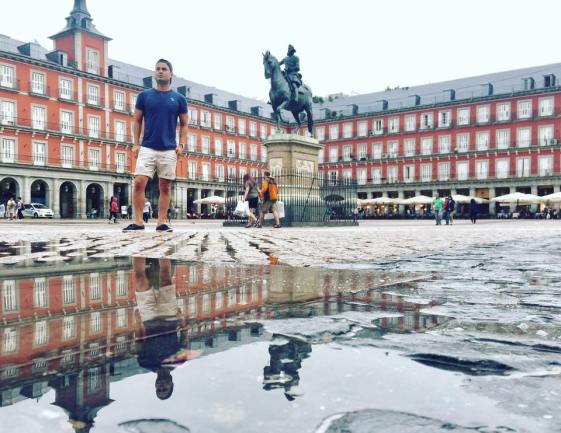
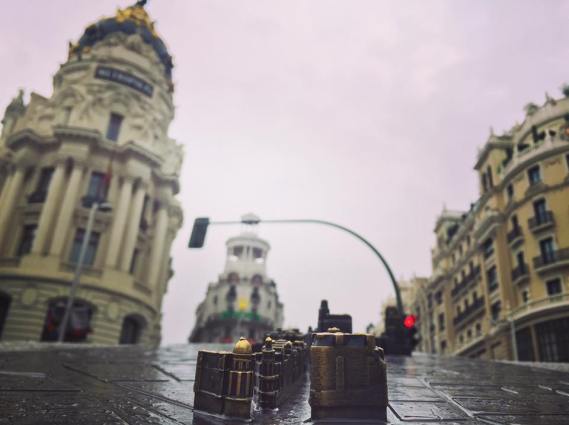
I emerge at Puerta del Sol Station at a time in which the warm rain colour the streets of the capital in tones of dirty reflections and commuters prepare for their tired journey home. My shoes squelch at every step through the Gran Via, which I follow to Plaza de Callao and up the pedestrianised Calle de Fuencarral. The trees around me swing with the light wind and their leaves slowly fall at the passing of yet another late summer rainy night. I decide to give the rest of the city a miss and enter the world of subways near Mercado de San Ildefonso.
At Barajas, my gate is changed three times and the flight is delayed by an hour. I reflect on scenes from the past featuring a familiar airport for both familiar goodbyes and for exciting welcomes -I arrived in Barajas first time I was headed for Ireland-. More importantly, I reflect on a weekend trip that has given me more than I could ask for, for this is family and this is what family is for.
Caminante, son tus huellas
el camino y nada más;
Caminante, no hay camino,
se hace camino al andar.
Al andar se hace el camino,
y al volver la vista atrás
se ve la senda que nunca
se ha de volver a pisar.
Caminante no hay camino
sino estelas en la mar.
-Antonio Machado
 THE FLYING CAMBA
I love it!
LikeLike