At four in the morning, a lethargic carriage steward knocks on our cabin door and shouts: ‘Passports’. Almost immediately, a sturdy immigration officer wraps his chunky fingers around the burgundy booklets and walks off. A sepulchral silence blends with the horrible taste of bad breath and poor sleep, filling the air of the small melamine-coated cabin with its sickening sensation.
The passports are returned and the train slowly marches through the dark plains of Macedonia. I have now lost any hopes of sleeping and instead, I lean my head against the cold window and see how the horizon unhurriedly populates with dim street lights. One by one, the streets around us bisect the railway from underneath, at times our train seeming to float over the lights of Skopje.
The early morning arrival. Few times in life will a memory be so intense. The weak legs stumbling across dark footpaths after a night of awkward sleep, the bad breath tying knots in the stomach, the lack of appetite, the state of alert despite the obvious fatigue, the distant landmark guiding the way into a safer and more populated area.
In the darkness of a Former Yugoslav city, numerous statues decorate roundabouts and squares. Brand new and groomed, they blankly stare at the beggars sleeping on their rocky pedestals.
The street lights go off at exactly six in the morning and a daunting tenebrosity engulfs the landscape. My heart rushes and I pace myself faster, my sweaty hands holding my phone as a reference for both light and navigation.
West of Macedonia Square, the avenues turn wide and Soviet-era apartment blocks mushroom squeezed in between the tall pine trees. I find my hotel in a quaint street dotted with two embassies and four B&Bs while I squeeze my legs desperately waiting for sunrise, for an open door and a toilet.
Once I am allowed to check into the small single room and treated to a free breakfast of sausages, eggs and a bit of instant coffee, I hit streets now transformed with the morning rush. School children carrying heavy backpacks, suited commuters hypnotised by their smartphones inundating the cracked footpaths, Chinese double-decker buses fighting their battle through traffic on each red light.
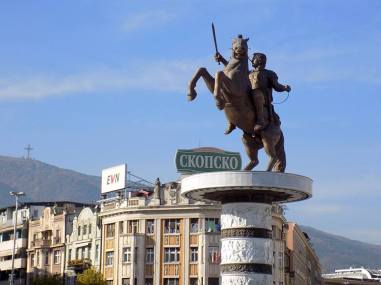
At Macedonia Square, an oversized and atrociously unproportioned equestrian figure represents Alexander The Great, although no locals can confirm this. He poses proudly like the centrepiece of a giant wedding cake of steel and glass, looking straight into the surrounding mountains now crowned by a gigantic 62-meter high steel cross.
– ‘That thing? That’s a giant lighting rod. A waste of money, like most statues in this country’.
The locals standing in the queue of the local bakery agree with the man at the till. Macedonia is still a very young country. with the contradictions of a young country. Ego and political national pride maintain the statues immaculate, while the rural areas of the country still suffer from lack of public services. The statues ceremoniously look towards the immaculate blue sky in the mid morning, their facial expressions a phony reflection of pride and at some level, a quest for long lost identity, years after gaining independence from the close eyes of Belgrade and Moscow.


In Skopje, the Vardar River divides the Serb from the Turk neighborhoods. Despite the differences, they seem to live in relative peace and everyone is as welcome for some tea and shisha next to the Old Bazaar, as for a bit of vodka and Pirozhki next to the Telekom Arena. I sip on my Turkish tea and indulge in the sweetness of a mid morning fresh baklava at the sound of a distant prayer call. The sunshine now creates lively silhouettes of stray cats over the tin roofs and heats up the polluted mountain air, turning it both dry and almost abrasive to the lungs.
Craving for some time to reflect, my hours in Skopje are spent in anti-social mood. Badly cooked burrito for lunch in what seems to be a hipster cafe, a long walk to the City Park, narrated by Lonely Planet as a haven of greenery in the middle of the city, though I find myself elbowing my way through the thousands of fans flocking to the Arena for an international football match.
Back in my small single room, I find enough room to stretch and exercise before ordering some takeaway and spending a night of planning next moves and purchasing plane tickets.
The night behind the tall pine trees turns cold and cast layers of thin fog around the now lit colossal steel cross sentineling from atop the highest mountain in the city.
The next morning, I watch the local news at breakfast and march alongside commuters to the main bus station , closely watched by the local shopkeepers selling dusty fruit and random household items that vanish as their storefronts are replaced by tall office buildings from where locals peak and stare at my colourful backpack.
Next to the platform, I order an espresso and spend my last Macedonian dinars before a dilapidated minibus pulls in and call for us.
Next to the platform, I order an espresso and spend my last Macedonian dinars before a dilapidated minibus pulls in and call for us.
Empty, the bus cruises along wide avenues for ten minutes before stopping next to an improvised bus stop surrounded by rubble underneath a pedestrian bridge.
From this point onwards is a full house. A mixture of men playing with their noisy smartphones and sporting buzzcut haircuts, women wearing colourful hijabs and sipping on cold bottles of water and a Canadian/German couple on-the-go for the day flicking through their passport pages.
From this point onwards is a full house. A mixture of men playing with their noisy smartphones and sporting buzzcut haircuts, women wearing colourful hijabs and sipping on cold bottles of water and a Canadian/German couple on-the-go for the day flicking through their passport pages.
Only twenty minutes later, our passports are again taken without a word said at an improvised checkpoint. A new stamp is hastily placed by an agent waving to the bus driver from his small PVC cubicle and the lot of travel documents are handed back in my hands to be redistributed amongst the passengers.
Behold the second newest country in the world, the Republic of Kosovo.
The customs officer stares at one of the wheels. The rim is covered in rust and the tire looks arguably flat. A few words are exchanged in Albanian before surprisingly being waved through. Gone are the flatlands of Macedonia, the terrain now turning surprisingly steep and dotted with makeshift houses, their tin roofs glowing at the reflection of the midday sunshine. We stop at a garage and we are told to vacate the minibus while two operators proceed to change the tire.
-‘Welcome to the Balkans’ the Canadian woman and I exclaim at the same time. It is her first time in modern-time Kosovo and for the next hour, she recalls visits to Albania and Serbia under the dictatorship, episodes lived under forty-watt street lights and random checkpoints.
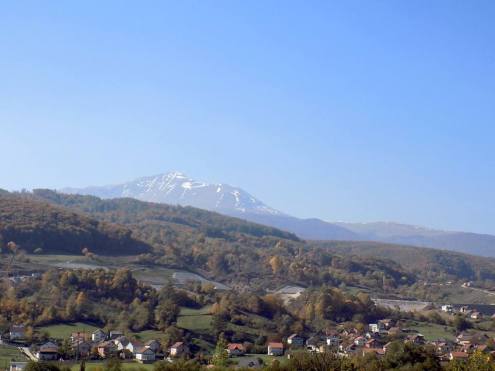
The air is sharply dry and a distant mountain gracefully decorates the horizon with its snowy top. The driver desperately tries to make up for lost time and his overtaking abilities takes us by a shocking and stomach-wrenching surprise. I feel the pain and desperation of a much needed bathroom break, my legs crossed and cold sweat dripping across my forehead as we drive past two major car crashes in the space of ten kilometres.
The urban sprawl grows larger and houses seem to have been built arbitrarily across the lifeless plateau. The road turns into a dual carriageway and Prishtina, the capital of Kosovo looks like a place nothing but aggressive.

Laws seem to have been lost. Nonsensical architecture aims to balance concrete structures as if gravity had no saying in their construction. Cars honk loudly through the main boulevard guarded by the three-story Bill Clinton portrait palely smirking at the congested avenue that bears his name. Outdoor advertisements hit the sight in an convulsion-inducing way and pedestrians fight their way amongst the chaos.
The newest nation in Europe has managed to attract considerable amount of both investments and EU aid within a territory in which fifty-two percent of the population is under 25. Excesses of typical youngsters are committed at every corner: brand-new cars loudly speeding towards dusty streets with no regards of pedestrians -their chassis numbers tampered to conceal the original owner, long ago filed as stolen somewhere else in Europe- ,the sea of faded haircuts gallivanting across the Mother Theresa Boulevard loudly playing Turkish music over their smartphone speakers.


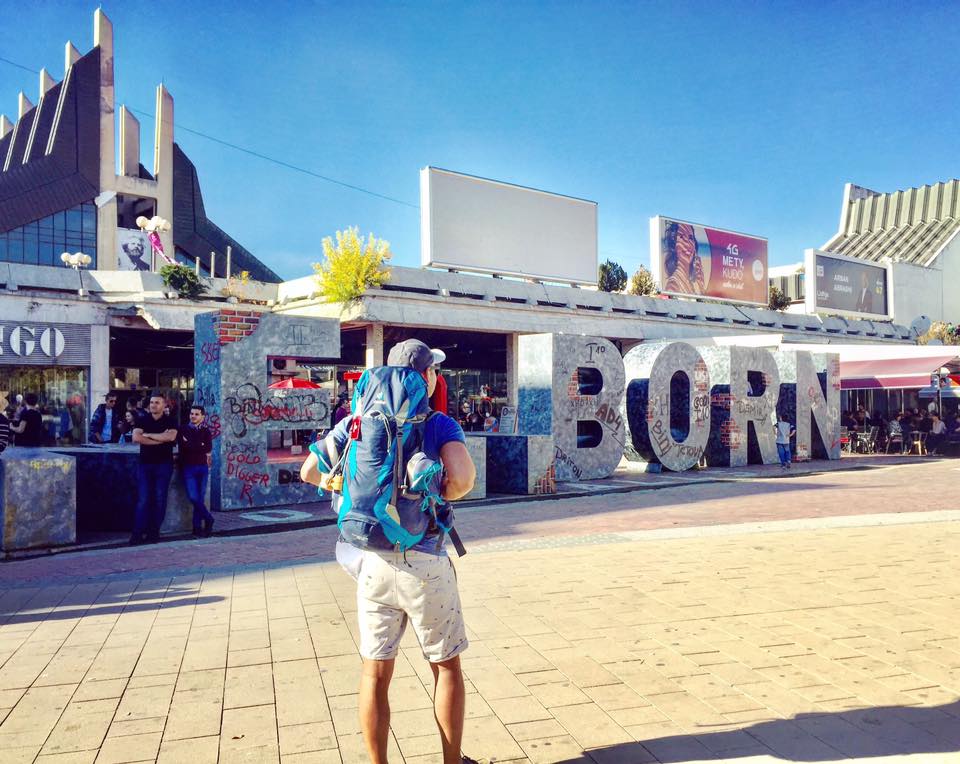
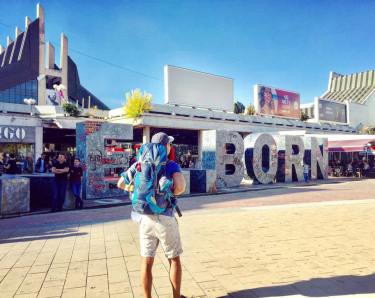
An hour is enough to exhaust all the tourist attractions in the city. The abandoned former cathedral and its crumbling red bricks at sunset, the main library and its Lego-like structure covered in a steel mesh symbolising the old and new Republic, the view from the top of the bell tower at Mother Theresa Cathedral, and the obvious picture next to the NEWBORN sign, a statement of acceptance and personal recognition of this new country.
There is more to Prishtina though. Its appeal to me perhaps lies more on the unknown, on what lies behind a young generation wounded by war and displacement. On every story hidden at Mother Theresa Boulevard, the place to be seen, mind-numbing memories of those that are desperately trying to forget at the unisone of techno music, wandering into the emptiness of a future as hollow as their pockets.

The Kosovars indulge on paper bags filled with sunflower seeds and cheap cans of beer, stretching as far as you could with a two-Euro coin. Back in the hostel, my Hungarian roommates and I decide to venture out for an evening of typical Kosovar cuisine, the gilded-coloured beer flowing in between large ceramic dishes of veal stew, the heavy wooden table blending amongst many others seating diplomats that can afford a ‘tenner’ for a lavish meal.
In the early morning, a taxi takes me to the bus station in the tranquility of the deserted streets. All traffic is gone at dawn, the time in which the young population sleeps in the cozyness of dilapidated flats subsidised by remittances and international aid.

An impressively modern motorway takes me out of the capital and, after a brief stop in somewhat picturesque Prizren, the monotony of the cold plateau is broken by the mountains in the Albanian border. The so-called ‘Friendship Motorway’ was built with Albanian money as soon as Kosovo gained independence to both show solidarity and impose trade links between the two countries, closing once and for all the Serb claim.
It is an open border between the two countries. The long tunnels cut through the rock in a rapid descent towards the sea level. Albania is next.
 THE FLYING CAMBA