
It is a bright morning over the Levantine coast, the warm awakening sunshine now entering through the airplane window as we start our final descent. A undecipherable message in Italian is heard over the speaker and, once I hear the words ‘Ben Gurion International Airport’, I realise that I have now left the confines of our immediate vicinity in Europe and I am now entering the Middle East.
Outside, the aircraft darts across the heavily populated suburbs of Tel Aviv, before dramatically U-turning for our final approach into the main gateway of Israel. At Ben Gurion International, I find myself walking through a portentous corridor sloping downwards, its magnificent brightness smothered at the arrivals hall, where police officers scrutinise passengers from small square booths dotting a poorly-lit concourse.
I am lucky and today, I am waved into the country in a matter of two minutes, no further questions asked. Outside the modern glass terminal, the country’s wealth can be seen screaming from the top of its lungs. International aid converted into modern motorways that wind around vasts fields of manicured gardens embedded in the middle of the sandy desert.
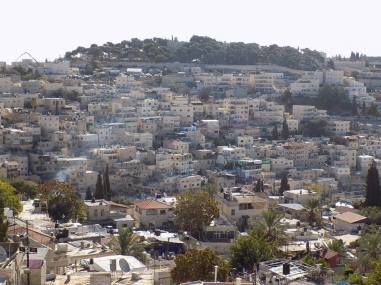
Sleep deprived, I fall asleep as the minibus enters a systems of recently tarmacked roads and wake up when the road grows bumpy and quieter, the settlements around us once again numerously climbing through the hills, luxurious condos protruding from the terrain in solid square shapes of pale brown stone.
I find myself cruising through the streets of Jerusalem, yet I do not understand it. Like a languid travel dream in which we seem to watch but not think, floating in a limbo of thoughts unsuccessfully trying to convey in the head at the same time.
Map in hands, I notice the Old Town, bisected by the infamous 1949 Armistice Agreement Line at Damascus Gate, fixing my course through it. I find my hostel squeezed in one of the narrow buildings of David Street and I take a deep depressed breath, the dorm room looking more like a mould-covered refugee shelter, towels and backpacks laid on a polish cement floor that palely salutes at the dim sunlight sneaking through the only window. Staying in Jerusalem would not be the same on a five-star hotel.
Tel Aviv might have the beaches, party scene and the bust of the new State of Israel, yet Jerusalem’s Old Town is where everything began. Where religions speak about the origin of life and thick walls encircle their history in four different quarters. Quaint alleyways and squares rule the Christian Quarter, whilst constantly-shouting merchants sell goods in an enigmatic organised mess at the Muslim one. The Armenian seems to almost blend with the Jewish Quarter, the difference laying with the many posters affixed on the stone walls graphically telling visitors about the Armenian Genocide.


At the Wailing Wall, chills are sent in shockwaves through my spine at the touch of the cold stone where for years, pilgrims have prayed and placed small pieces of paper in either a gesture of thank or prayer for someone in need. Around me, loud Spanish-speaking tourists laugh and take selfies against the wall, while a short Jewish Orthodox priest quietly recites pieces of the Torah in an hypnotic position of pure trance.


Once the sun sets behind the Damascus Gate, the city shifts its attention outside the thick cold walls.
The shops close for business and the narrow streets within the Old Town grow pleasantly serene, like the bare skeleton of millenial trade now staring at the clear night in silence, a haunting full transformation to last until the next day. Traders return home and tourists leave for their hotels at a time in which Yaffo Street reverberates at the sound of high-pitched music coming from the many restaurants that are now open for business.
Yaffo Street is a proud representation of modern Israel. Selfies taken against giant vinyl hashtags at Tsylon Square, rows of department stores selling American brands and the Yehuda Market, reinvented at the touch of every night.
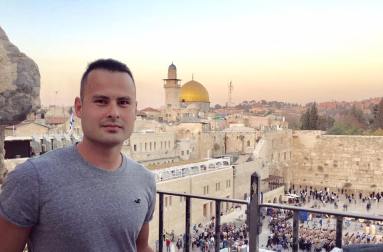
I meet a local friend in one of the many stalls selling dates during the day and expensive alcohol during the night, the happenings of our eventful lives catching up with us since that improvised trip to the Dingle Peninsula, to times of Couchsurfing and melancholic cycles with half-healed broken arms. In half a decade, an episode of cancer became a game changer, turning the conversation both sweet and sour at the flick of every minute. Further studies, apartment hunting, past and present jobs in both Dublin and Jerusalem. The expensive bottles of beer are placed in the foldable tin table by a dark-haired tattooed waitress, her temperament as intimidating as the loaded guns hanging off the clueless-faced youngsters’ shoulders. The guns point downwards and are displayed like some sort of accessory with the same pride locals in Kampala find in their smartphones.
– Are those guns real? That guy is not even in uniform.
– When compulsory military service is over, we are allowed to ‘wear’ our gun for a year after. Like a year of grace.
And with such exchange of words, the new Israel now makes sense. The young Israeli travelers seen backpacking in the beaches of Zanzibar or hiking in Torres del Paine, their dark eyes open to the fresh air in tones of desperately sought freedom, so temporary yet so necessary. An apartment in Jerusalem have the same cost that its counterpart in Dublin yet the wages are lower. Healthcare in Israel is notoriously better than many countries in the industrialised world, including the United States and Ireland, and Europop music in Jerusalem echoes as loudly as any nightclub in Leicester Square.
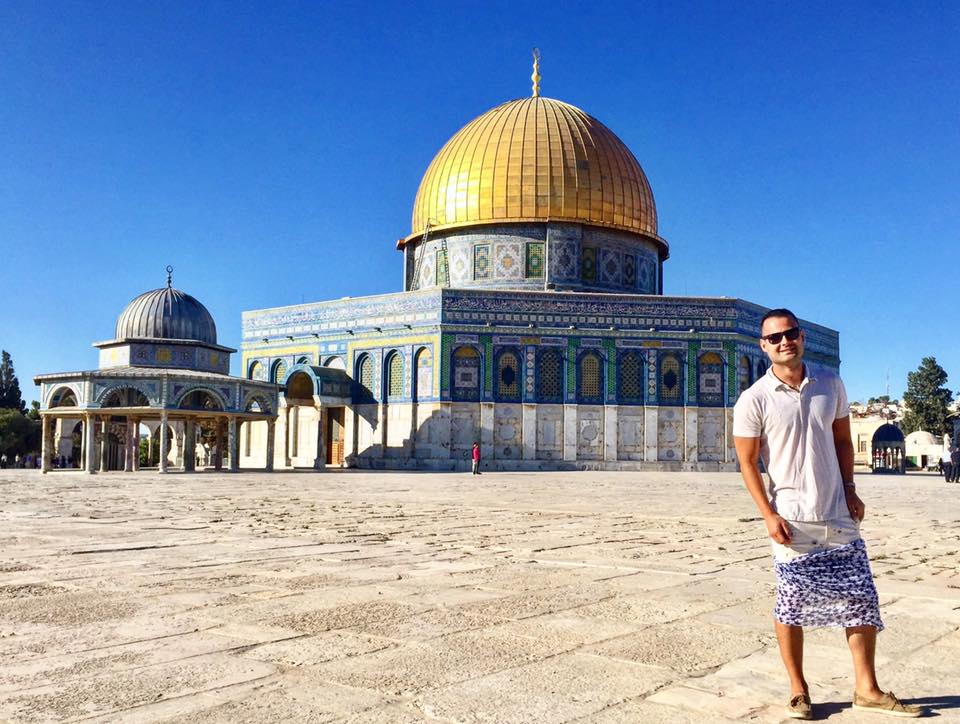
Unable to sleep at the now dearly named ‘refugee hostel’, I lose myself in the emptiness of the Old Town before sunrise, later caressed by rays of sunshine beaming through the narrow corners around the entrance to the Dome of the Rock, where a long queue is already forming since five in the morning. A Danish couple lines next to me and, whilst I hope for my shorts to be overlooked by security, we chat about our impressions of Jerusalem, later given a private history lesson about the place we are about to enter.
Underneath the golden dome roof, the most sacred of places for many religions lies heavily guarded. It is here where claims for the origin of life converge, the place where God created the humans. The shaved top of a rocky hill touched by the holiness of beliefs, faith and conflict.


Once a place zealously guarded by Christians, now a Muslim structure. An architectural icon of white and turquoise marble, its solid walls covered in Quran encryptions preventing Non-Muslims to see the inside, the spark of resentment in the Jewish community, at some stage wistful to build their own mega Hebrew temple to celebrate the future coming of the Messias, to happen through the golden arches once built facing towards the Mount of Olives, now concealed with a heavy marsh of stones and mortars within the Eastern side of the complex.
For the next hours, I lose myself in the tense magic of the Old Town. Narrow passageways shared with jolly rabbis, their curly locks bouncing at the rhythm of every step, Armenian flags timidly waving a greeting to the fresh Westerly wind, echoing calls of prayer filling the air with its hypnotic and sad tone.
I finish the day at the Mount of Olives, at five in the afternoon the eternal springly weather tinting the air orange and throwing gilded light over the countless tombs that now climb on one side of the hill like a marble staircase of Jewish memories pointing towards the sky.
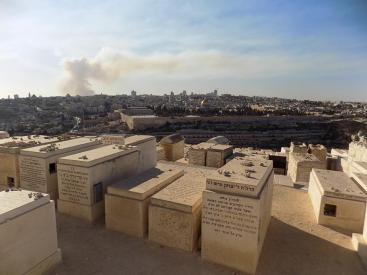
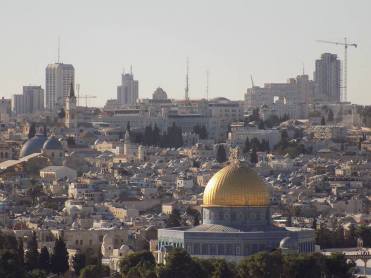
I sit down and take a deep breath in one of the most religiously evoking places on Earth, whilst my mind struggles to piece together both memories from Catholic school and this day. Beautiful and sacred, Jerusalem is also weary and hostile and, although no fire was heard today, my stomach twists at the sight of young military personnel sporting their heavy guns, their frail body frames in a struggle to hold the belic artifact as reluctant as their frightened lost eyes, staring in a constant state of alert across a city of constant change.
I decide to leave Jerusalem the next morning, before the next Sabbath starts and the urban conglomerate of East Jerusalem vanishes behind lifeless mountains, the bus now dipping below sea level towards the shores of the Dead Sea. Next to the National Road, large red signs warn in three languages:
‘THIS ROAD LEADS TO PALESTINIAN VILLAGE – THE ENTRANCE OF ISRAELI CITIZENS IS FORBIDDEN -DANGEROUS TO YOUR LIVES’.
To my surprise, I notice we are now cutting across the West Bank and across the tinted air-conditioned windows, the settlements turn precarious and decayed.
It is yet another beautifully sunny day in the West Bank. In the distance, small terracotta buildings emerge from the distant mountains surrounding Jericho, the cradle of humanity, while next to the road, the tall double fence reminds me of the arbitrarily-imposed geographical limits between the State of Israel and the rest of the Arab world.
We stop at a checkpoint and two young officers heavily stomp into the bus and check our travel documents. The heavily framed girl looks no older than eighteen years of age and her round olive-coloured eyes jump from her tanned skin like two pieces of emerald stones embedded in a bed of curly hair. She grabs my passport and flicks through pages and pages of stamps. Her comrade, a short bearded boy of about the same age holds onto his gun and looks over her shoulder. She clears her throat and proceed to interrogate:
– Where are you coming from?
– Now or in general? Now, Jerusalem.
– Where are you going?
– Jordan.
-Do you have friends in Israel?
– No.
-Do you have friends in Jordan?
– No.
-You traveling alone?
– Yes.
-Why?
– Because I like doing so.
-Here have your passport.
My shaky hand holds onto the burgundy booklet and on my mobile screen, I see how we have now left the West Bank and I have been allowed back into Israel despite not having yet left the country. I change buses at Beit She’an and, despite the few road signs advertising resort hotels in the nearby Sea of Galilee, my head faces straight East to the border.
My heart races in a pace of frustration when clearing border formalities and, just as the compulsory military service imposed to every person aged between eighteen and twenty one years old in Israel challenges the frail personalities of generation after generation of Israelis, I join in the same feeling of the wandering ones overindulging in the beaches of Phuket or the bars of Buenos Aires, for I keep in memory the unique beauty of the places in the country, yet I find leaving Israel the most liberating feeling in my mind.
 THE FLYING CAMBA