

The elegant black with red stripes Airbus sets course straight South and flies over Wadi Rum until it meets the sea at Aqaba. Like having touched an imaginary wall, the aircraft sharply veers right and heads West towards Sinai. The shortest way between Amman and Cairo is not straight line but instead, a blatant avoidance of Israeli airspace.
I see the Suez Canal seconds before starting our final descent, floating in between patches of fog and sand. Outside the aircraft window, everything seems to transcur in a violent sprint. Sandcastle-like apartment conglomerates emerging from the fog an instant before the aircraft nose violently points upwards before kissing the hot runway.
At Cairo International Airport, the foreign passports queue remains vacant as a result of a constant decline in tourists numbers. Terrorist attacks, coups and violent protests have taken place in what once was a booming destination, placing Egypt in many ‘travel warning’ government sites, deterring both investment and visitors to land in these dusty lands.
It is almost midday and the local five Egyptian pounds bus -quarter of an Euro- is too tempting both for price and experience.
Minutes after leaving the airport, Cairo strikes. Cairo with its almost twenty million inhabitants is a monster. It grabs one by the head, before chewing and spitting individuals into a surge of non stop honking and standstill traffic. If not enough, it smothers everyone in a thick layer of smog and dust, enough to stick in the back of the throat and induce sickness right into the gut. The entire city is covered in a fine layer of pale brown dust. ‘Saharan dust’ I believe.
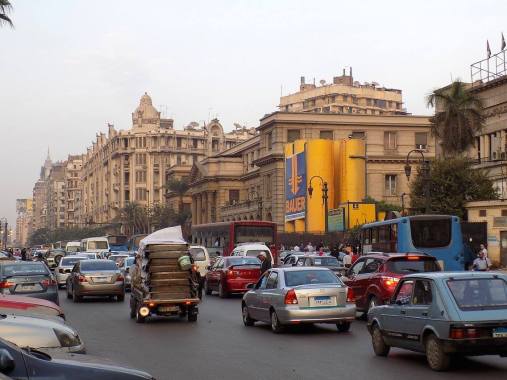
The bus manages to reach Ramsis Station and, below the collapsed underpass, pedestrians play a sort of Russian roulette with cars and minibuses coming from every possible direction. Before I know it, I am almost hit by three cars in the space of ten minutes. My loud cursing is muffled by the constant car honking and, just like the locals do, I decide to cross the streets when they do, running across the road in clusters of commuters playing lotto with their physical integrity. With barely an hour in the Egyptian capital, I check into my hotel, which occupies the last two floors of an abandoned-like building and exhaustingly nap, the pink walls around me decorated with gilded-painted imagery of pharaohs and the full blasting air conditioning rocking me into a brief rest.
I face Cairo when the sun, concealed by the thick layer of dust and smog, declares truce in the late afternoon and the city then becomes surprisingly understandable.
Like some sort of rite of passage, I see how the complete disbelief at both the traffic laws -or lack of- and the aggressiveness of a place that simply does not seem to stop, turns into anger at people that seem oblivious to the principle of physical integrity, finally giving way to acceptance of the surroundings and adoption of mechanisms to survive.
The main avenues converge at Tahrir Square, centerpiece of famous political change in the Arab World, riots and clashes between civilians and politicians calling the Arab Spring some half a decade ago. The roundabout looks surprisingly peaceful today, in the afternoon, the sun setting behind the West bank of the turbulent Nile which cuts through the city slicing it into two halves.


To understand Cairo, one must understand that Egypt has a history of constant hardship taking place in an inhospitable land, bearing one of the most difficult weather conditions on Earth.
Its capital is no exception to the rule and a ride on the metro, one of the busiest mass transit systems in the world, will give you a scope of the essence of its inhabitants from its very core: the families led by the husband, the children playing with pink plastic toys at the stern gaze of the mother, the new millennials holding their hair with thick layers of sticky gel, blankly staring at the carriage’s vibrating melamine panels, the solitary women in burkas, their eyes contemplating an episode of urban life with the unique mystery of what lies beneath their black veils. At Giza Station, the city seems to have officially given up on planning laws and unfinished buildings splash in between piles of rubble and elevated highways clogged in standstill traffic.
Patience. First taxi ride and the driver does not understand the word ‘Sphinx’. Second taxi ride and the driver, using his smartphone, types 1-0-0 for a ride worth less than half that value. I find myself sweating in the middle of a congested avenue and laughing at my own anger, for at the end of the day, ‘nothing is easy in Egypt’.
A third driver turns on his meter and waving his hands in a pointy tip above his head mouths the word ‘pyramid’. Shanty towns and kebab places on every corner, rickshaws and white minivans at every turn. Before I even have time to react, the surreal sight of pyramids emerging from the slums stops my heart.
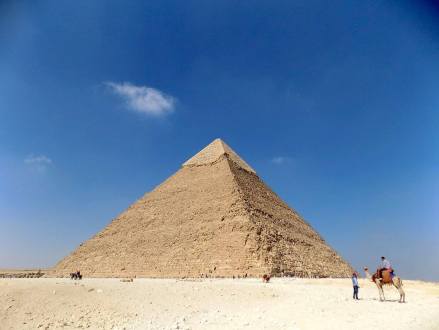
A lifetime wish. My mouth feels as dry as the streets around us and my heart races as fast as the traffic left behind. I feel an urge to get out of the taxi and run towards the site, wasting no time in indulging in a place I have been wanting to see since I have memory.
Giza has succumbed to the peculiarities of tourism and, just like a bad Egyptian curse, the local economy has casted a spell of desperate necessity in the tour guides, who now attempt every possible scam to retrieve a few extra pounds from visitors. In fifteen minutes, I see tour guides disguised as police trying to hold onto tickets, souvenir sellers desperately scoring for tips, overly friendly smiles at every steps, ‘g’days’ , ‘good morning my friend’ and fake hand shakes at every passing meter.
I take a deep breath and try my best to politely decline, for Cairo has taught me that its people will do anything to survive, and this is just one of the many mechanisms to do so.
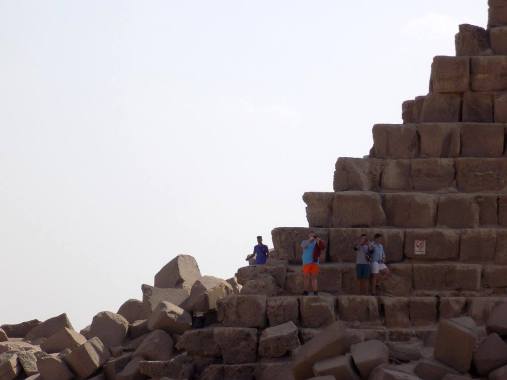
Gobsmacked by the structure standing right in front of me, I enter into a trance state of typical tourist mind. I balance my weight against dusty ropes and take as many pictures as I can, oblivious to my shoes filling up with dust and small stones.
Foreign tourists seem to be scarce, while the eager local kids in school uniforms assembly around me to take selfies with their borrowed cameras.
Keops is the largest pyramid in the complex. At over one hundred and forty meters of height, it elegantly surveils the entire site with its two million stone blocks piled in an accuracy so perfect, it is thought to be strategically aligned with the stars above and, at some point, thought to even been built with the help of some extra terrestrial power.
The Sphinx is smaller than I imagined and its noseless image seems to sadly look at what was once a vast fertile land extending to the shores of the Nile, nowadays cluttered with slummy suburbia.

A horseman introduces himself and Sara, who I immediately fall in love with. Sara is tame and her round eyes talk about long days in the desert. Different to the sick-looking camels posing for pictures, she looks well taken care of, and a connection is felt as soon as I pet her forehead, sold afterwards. Sara sets a galloping pace away from the complex of six pyramids and tourists, from the top of a soft hill looking away South to the Sahara, at midday charred by the ever present sunshine.


When energy is worn and a lunch is eaten with a view, I grab a taxi that blatantly overcharges me, my own GPS skipping North of the complex along avenues of stopping buses and passengers left behind in the middle of the four-lane road, South at one hundred kilometers and hour in a elevated highway soaring over the slums of Giza. I sigh and already too exhausted to argue pay the fare, the metro at the board the metro at very last stop cruising along station after station of passengers that congregate in the carriages sighing in fatigue, the golden rule of the city.
Fed up with Cairo, I decide to stay away from it on my last day. The trains in Egypt are comfortable, although purchasing a ticket remains a challenge. Not a word of English spoken at the counter, not a word of Arabic spoken on my side. The attendant frustratingly grabs my money and hands me a second class ticket, although I am charged for first.
The train pulls out of the gilded lobby of Ramsis Station and kilometers of shanty towns and unfinished buildings give way to a fertile flat esplanade, the Nile Delta.
It is a fast two-and-a-half hour journey to Alexandria. The land around us growing greener and the air turning more humid as we approach the coast. Despite piles of rubble from what in Egypt seems to be an eternal state of roadworks, the city breathes a Mediterranean air blowing straight from the choppy sea, cleansing the smog coming from the traffic-clogged streets.
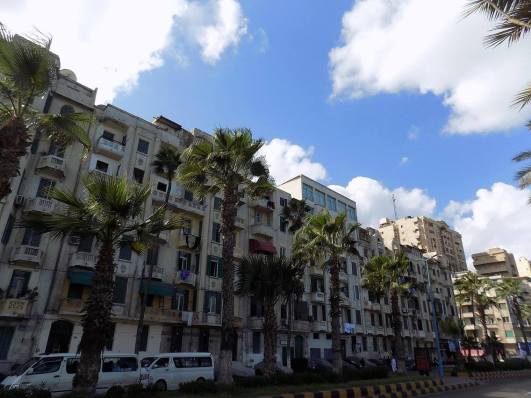
I find some comfort -euphemism for bathroom break, food and wifi- at a McDonalds, the attendants particularly interested in interacting with the panting tourist.
– ‘Do you like Alex?’ Asks the manager, whilst printing off bank statements.
– ‘Yes, I have only been here for thirty minutes but I do’. I reply.
–‘We want tourists to come and visit and see our pretty city’ She replies while asking me to sit down and wait for my meal at the table.
Like every place in Egypt, Alexandria is a place that seems to have had better days. A bit of Nice, a bit of Rome, the C-shaped corniche encompasses the core of the city and provides it with shelter from the inclement sea spray outside of it. On one end, the Citadel and Fortress adorn the busy West end, whilst the refurbished Biblioteka Alexandrina, a legacy of Ancient time, frames the quietness of the East. At Cafe de la Paix, I sip on the last Turkish coffee of the entire trip and watch the day die, one by one, the families catching minibuses back to their houses after a Friday of fun by the sea, the sleepy children looking directly into the dim sunshine above them whilst their ice cream cones melt in their hands.


I walk back to the train station when the night falls and a full moon casts a silver light over the rooftops of the dilapidated buildings. The train slowly gains momentum through the Nile Delta and the neon lights coming from shanty nightclubs laid on the villages dirt streets become blurry and are for me forever gone.
The drive from Ramsis Station to Cairo Airport is never to be forgotten. Alleged shortcuts through the heart of shanty towns, our wheels barely escaping to the locals pulling tables and playing backgammon in an overnight tea-induced frenzy, streets turning into avenues that soar over half-built buildings now hidden by gigantic outdoors selling Western dreams of KFC and property developments built in Americana only a mere and unattainable aspiration for most Cairenes.
Whilst waiting for my flight to open for check in and short of Egyptian pounds in a painfully boring airport, I reflect on the bizarreness of Cairo, on the little value that life seems to have to the twenty-something million inhabitants, daily struggling with its smothering nature at the sighs of both fatigue and resilience.
I lean against a table covered in spilled Fanta at Burger King and wait to board my prehistoric-era Boeing 767 out of the Middle East, which departs with a slight delay at two in the morning and U-turns across a cotton candy-like sky.
The flight is empty and I am not bothered with the light snack. I sleep to wake up to a lush green landscape desperate to scratch our wings. Our aircraft briefly prepares to land at Addis Ababa Bole International, the high-altitude terrain shortening our distance to the ground and home of Ethiopian Airlines.
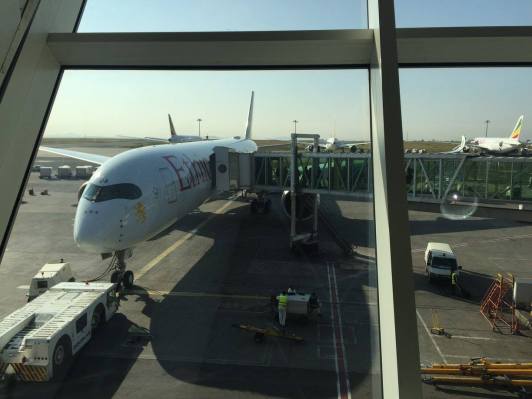
Very little time is conceded for connecting in the growing airport. A toilet break is almost prohibitive in the cramped portable bathroom awkwardly placed in the middle of the terminal yet to be fully built, yet I am pleasantly surprised to find myself boarding a brand new Airbus 350 South of the Equator.
The African morning flicks from winter to summer in a magic only achieved by air travel, five hours later and just over Harare, the captain announcing our final descent into the hot plains of Gauteng, O.R. Tambo International Airport opening its two runways to the largest city in this part of Africa: Johannesburg.
 THE FLYING CAMBA