
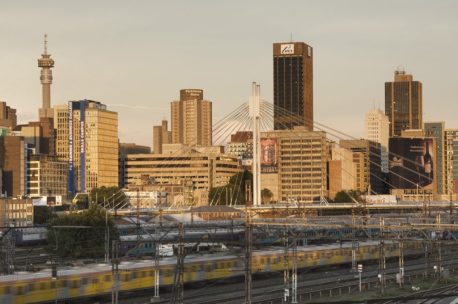
As the automated doors open into a large lobby and the escalator takes me up to the platform for the Gautrain, I notice how the largest city in South Africa seems to float in a limbo of pure contradictions. Jo’burg is far from being an impressive holiday destination, the city in past and present object of headlines involving street violence and petty crime.
As we rapidly advance into its core at Johannesburg Park Station, the fences around us grow claustrophobically higher, blocking entire views of round dry hills and bungalow-splattered suburbia laid in extensive patterns of security systems obsession.
English is fervently spoken in Sandton, while in Randburg and Roodeport, braais are enjoyed around a mostly Afrikaner conversation. In distant Soweto, the horizon still looks gloomy after years of so-called freedom and, in the desolation of a Saturday afternoon in Braamfontein, where children beg for coins and whites avoid eye contact with blacks, my mood grows incredibly worn out.
The early summer thunderstorm refreshes the stale urban air outside of my open hotel room window and muffles the loud music from one of the shady nightclubs below.
At the lobby, a thirty-something Japanese tourist approaches me and invites me to join him around the unattractive CBD and scout for food. Oily fish and chips for dinner, bottle of water in hands and sleeping the throbbing headache the plans for the rest of the evening.
In the morning, a bus journey to my next country is scheduled at seven hours. It is a crisp Sunday morning, the light traffic turning the road to Pretoria into a pleasantly smooth stretch of suburban landscape. At Pretoria bus terminal, which sits next to a gorgeously Colonial-built train station, a blonde balding man heavily relinquish the weight of his dense body frame on the seat next to mine and sighs while sipping on a small bottle of water. He cleans the sweat off his forehead and his face turns friendlier. For the next two hours, he speaks of bygone boer times and childhood summers playing in the farms of Groot Marico and his natal Rustenburg.
-‘It is a fine place. The city is right in a valley and sadly, the road bypasses it. You should visit it sometime’. He mutters as he grabs his small backpack and prepares to vacate his seat, the double-decker bus stopping for a lunch break next to a McDonalds awkwardly placed contiguous to the slip road entering Rustenburg.
The traffic over the smooth road becomes quieter as we approach the border, the speakers on the bus now playing the dialogs of a blatantly brainwashing Christian movie about white Americans thanking for their overpriced brunches in New York. Outside the tinted window, the sun sets over the horizon of sterile vegetation in an incandescent beauty unique to Africa.
At the Kopfontein border post, the fingerprinting machines do not work and the queues extend for over a hundred meters over the hostile tarmac road. The bus stewardess smiles to the queue, and one by one more smiles spread like an inexplicably epidemia of resignation.
– You’re white, why don’t you go to the front of the queue?’ is repeated to me by many.
I wave my passport and take my spot in the ‘Foreign Citizens’ queue, where most Botswanans are now awaiting for clearance to depart South Africa.
-‘Sorry. This is Africa my son’.
-‘Are you going to Bots? If you need a lift to Gabs, let us know. You’ll see how things are different in my country, you are going to love it’ , says a woman sweating through her bright red dress and munching on a pack of crisps.
Seven hours after having left Johannesburg and notoriously frustrated at the long wait at the border, I am waved out of South Africa and into Botswana long after the sun hides, too exhausted to wait for every passenger on the bus to clear immigration.
Next to the border post, a man awaits for his brother passenger on the same bus and offers me a lift to the capital, only fifteen minutes away. They hug each other and carefully place my bag in the haul of a brand-new Corolla. Zambians, they brief me on the peculiarities across the Southern Africa borders, customs, racism, attitudes and even culinary specialities.
At every passing minute, and despite the poorly-lit streets of Gaborone on arrival, I feel the tension around my shoulders finally deciding to give way and unwind to the rhythm of this region of the world, mumbling a light ‘TIA – This is Africa’ while I eat the slices of a delivered pizza and dip in the lodge’s swimming pool, at nine in the evening caressed by the full moon.
Steady and almost leisurely grown, Botswana with its two million inhabitants is a remarkably quiet place. Botswanans take pride in their country’s modest achievements and refer to it with pride when comparing it with ANC-ruled South Africa and Mugabe’s Zimbabwe. Botswanans come across as modest when engaging into small talk at the train station ticket counter or at the supermarket till, though some form of radical protectionism is felt when digging deeper into conversation about economy and migrants from neighbouring borders.
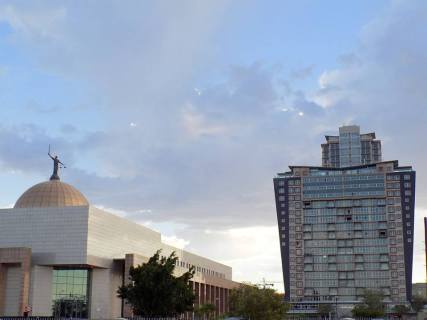
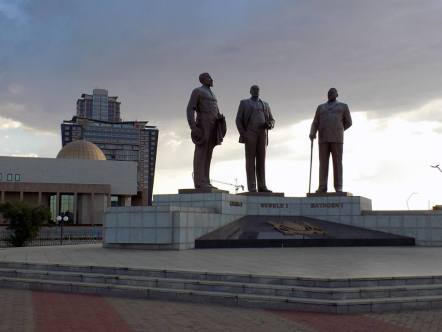
A largely rural country, Gaborone concentrates about half a million of the total population and, emerging from a previous bushland, the newly-built CBD endures the heat of the day at the inexistence of trees, while two tall apartment towers clumsily protrude from the flatland in a sight familiar to the early stages of Dubai. The Three Ditkosi turn their back to the skyscrapers being built behind them, the prevalence of old African values staring to the bare and almost infinite bushland in the front, with the inevitable sign of progress following from the back.
A short walk around Gaborone shows both, a massive desire of consuming in the freshly-painted shopping malls, and a country in clear development as seen in the frenzy of village-bound white minivans cramming the neighbouring bus depot. At Mena Towers, strawberry daiquiri in hands, the waitress smiles and introduces herself from the side of the leather couch.
-‘I hope you’re enjoying Bots’
-‘Yes. It is very quiet and relaxed here, I like it’.
Shortly after, I learn that Botswanans take pride in education, reflection of it also seen in the tidiness of the streets running along the capital. The Botswanan economy is consolidating a privileged spot in the Southern African region and the president, a former Colonel at times running the country with an iron fist, is liked by most of the population.
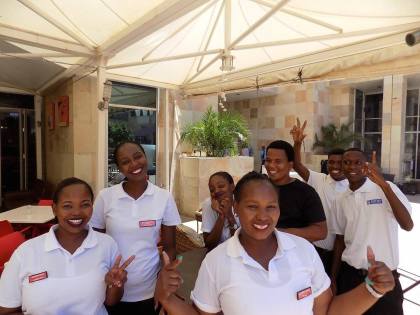
Once I finish my drink, the waiting staff bring bread sticks covered in garlic cloves –‘on the house’ – and the restaurant manager, looking at the camera poking out of the blue backpack, asks me to take a picture of the entire staff.
At nearby Mokolodi Nature Reserve, an interesting and inexpensive opportunity for a bit of a game drive is too tempting to give up and, only a thirty-minute taxi ride away, the wooden gate opens to a welcome centre nestled in between the soft hills that separate the bushland from the suburbs of Gaborone and the South African border.
Once the receptionist announces my private jeep is ready, I am joined by a blonde French girl for a three-hour game drive around the reserve. We are tossed around dirt tracks of fire-coloured land, climbing hills of countless tones of green and brown. Across shaded oasis where elegant antelopes shelter from the sizzling heat of the day. At the water hole, crocodiles share a romance with two heavy hippos, their nostrils protruding from the grey thick mud in sepulcral discretion. And just at the end of the game drive, a male giraffe camply poses for our lenses, extending its black patches embedded in a lush dark orange skin towards a tall leafy tree.
As a rule of thumb in the late afternoon, a tropical storm creeps into the city and flirts with the ample horizon of Africa, a horizon in which space seems to expand in ways almost too gigantic for humans, rendering us minusculus around the immensity of the bush.


I accidentally meet with the red-dressed woman that had queued with me at the South African border and as soon as she sees me, she smiles with the same perspicace of the waiting staff at Mena Towers or the receptionist at Mokolodi.
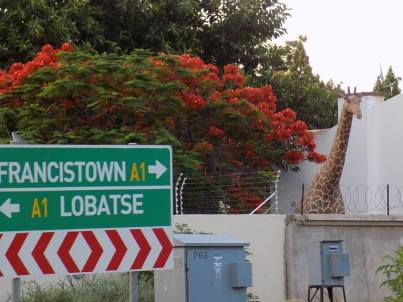
At the train station, the most modern sleeper train I have ever been on is performing the overnight service across the country. Air conditioned cabins kept spotless, fresh linen, snacks and onboard wifi, the train from Gaborone to Francistown becomes one of the highlights of my time in a country full of surprises and, right on the dot, transports me across its extensive confines in style.
Eight hours later, the train pulls into Francistown train station at the pale light of the morning in the savannah. I count three shopping malls within a fifteen minute walk, shutters still down as the second largest town in Botswana slowly wakes up from its bushland lethargy and the sun rushes to heat up the air. I indulge in a coffee and an American-style breakfast at the locally-loved Wimpy, alarmingly withdrawing Pulas from the bank and changing them into crisp US dollar notes.
At nearly eleven, under an almost prohibitive sunshine, an elderly woman places her wooden stall next to a Texaco slip road and sells bus tickets to a waiting crowd loaded with canvas bags full of supplies and toilet paper rolls.
Delayed, the Seabelo Express from the capital arrives and passengers rush around it, the previously empty cargo haul explodes with luggage, groceries and plastic toys within seconds. After several runs across town, I mentally celebrate the departure from the stuffy incarceration of the Francistown suburbs and the driver, aware of the massive delay now incurred on the total travel time, hits full gas over the Northern Highway , hitting the breaks only when signposts limit speeds and with that, limit the borders.
Queuing under the refreshing air-conditioned breeze inside a large pink-coloured building, a trio of women fan their sweaty foreheads with their green passports and discreetly look at mine.
-‘My name is Esther. Can I see the stamps on your passport?’, one of them assertively asks while flicking through the pages.
One by one, we are called into the attendant booths and waved out of the stern-ruled and progressive Botswana, out of the comfort of the air conditioned building to the scorching thoroughfare separating it from the daunting and little-known happenings of Zimbabwe.
 THE FLYING CAMBA